EU social partners unveil main findings of the Skills and Work Environment project

The social partners of the European Social Dialogue Committee (SDC) for the postal sector met today at the final conference to present the main findings of EU project the “Postal Skills and Work Environment in the Digital Transition: New Reflection from the Social Partners”.
In her keynote speech, Mrs. Maria Luisa Cabral, Director for Quality Jobs, Working Conditions and Social Dialogue at DG EMPL, underlined the key role of social partners and social dialogue in shaping future‑proof jobs, building on the European Commission’s Quality Jobs Roadmap. She highlighted social dialogue as a driver of change in delivering the future of work.
Botond Szebeny, Secretary General of PostEurop, added: “When technology is developing quickly, training and skills development remain the best tools for companies as we continue to face the postal digital and environmental transition.”
The EU project “Skills and Work Environment in the Digital Postal Transition: New Analysis from the Social Partners” was launched in September 2024 as a joint initiative of the employers’ and trade-unions’ organisations in the postal sector within the framework of the European Social Dialogue Committee for the Postal Sector (SDC). It was implemented by the Training, Health and Safety working group of the SDC for the European postal sector.
Aligned with the EC’s Quality Jobs roadmap, the project’s main objective is to support European social partners in developing a clear and forward-looking understanding of how work organisation, professional profiles and skills in the postal sector will evolve over the next decade. It also aims to help design effective training strategies that anticipate workforce needs. In addition, the project enables participants to assess emerging occupational health and safety (OHS) risks linked to digital and hybrid workplaces.
Building on the previous SDC project “Postal Skills and Work Environment in the Digital Era” (2020–2023), this initiative broadened the analysis on postal skills by extending the forecast from five to ten years and expanding the scope to four postal-sector occupational work activities:
- Post Office Networks
- Call Centres and Customer Care
- Sorting Centres
- Delivery of Postal Items
Project methodology
The project adopted a hybrid methodology, combining qualitative and quantitative analysis, implemented through three phases:
- Desk research to collect quantitative and qualitative evidence on the occupational profiles, sectoral dynamics and transformative trends that influence future skills requirements.
- Predictive modelling through machine learning to forecast future skills and training needs across the four occupational families over a ten-year horizon.
- The interactive seminars (held in Rome, Riga, Athens and Paris) bringing together experts, postal operators and trade-union representatives to validate findings, further explore scenarios as well as enrich the analytical outputs.
An innovative data‑collection approach was introduced during the seminars. Participants engaged in role‑play exercises facilitated by a GenAI‑powered chatbot trained on a curated postal‑sector knowledge base. This enabled real‑time interaction and generated insights that directly informed the refinement of the predictive model. Together, these processes produced a robust evidence base for understanding future skills needs and supported the development of training recommendations.
Key insights and outcomes
The insights generated through the seminars validated the labour‑demand forecasts produced by the project’s predictive model. The analysis examined expected developments in employment, future skill requirements and emerging Occupational Health and Safety (OHS) trends in the postal sector. This work formed the basis for a Training Pathways Catalogue, designed to provide social partners with a practical tool to shape, adapt and strengthen training programmes.
The catalogue supports postal organisations in preparing their workforce for future challenges by anticipating and addressing skill needs, while helping to mitigate the risk of skill shortages that could affect service provision, operational continuity and workforce planning. It offers a structured blueprint to review, refine and enhance existing training provision, ensuring alignment with future skill requirements over the medium to long term.
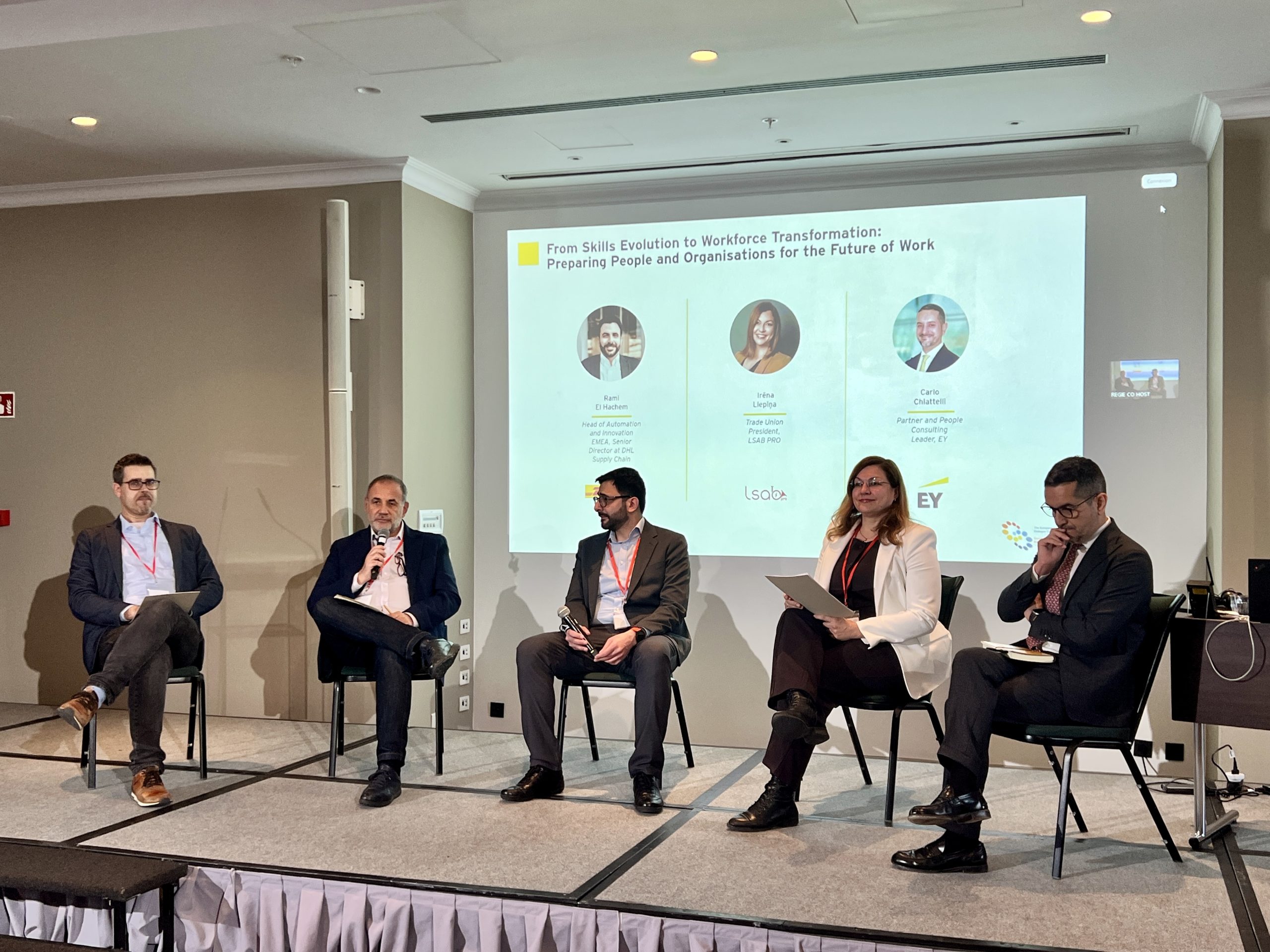
The final conference concluded with a show‑and‑tell presentation by Rami El Hacehem, Head of Automation and Innovation EMEA and Senior Director at DHL Supply Chain, followed by a roundtable discussion to further open the debate on preparing people and organisations for the future of work.
About PostEurop
PostEurop is the association representing European postal operators. It is dedicated to supporting and developing a sustainable and competitive European postal communication market that is accessible to all citizens, ensuring a modern and affordable universal service. Its members employ 1.6 million people, operate over 212,000 service and pick-up points across Europe, handle billions of items annually, and deliver to over 295 million homes and 48 million companies across Europe.
The European Social Dialogue Committee for the postal sector is composed of representatives of the postal employers (PostEurop Social Affairs Committee) and trade unions (UNI Europa Post & Logistics and CESI) of the 27 EU Member States. Its activities are supported by the European Commission.
For more information, visit www.posteurop.org, European Social Dialogue Committee, UNI Europa and CESI.
For more information, please contact:
Francesco Barbaro-Costa
Chair of the SDC Health & Safety working group
E: barbarof.costa@posteitaliane.it
Margaux Meidinger
Head of the European Social Affairs Committee
E: margaux.meidinger.laposte.fr
Cynthia Wee-Neumann
Communications Manager
E: cynthia.wee@posteurop.org