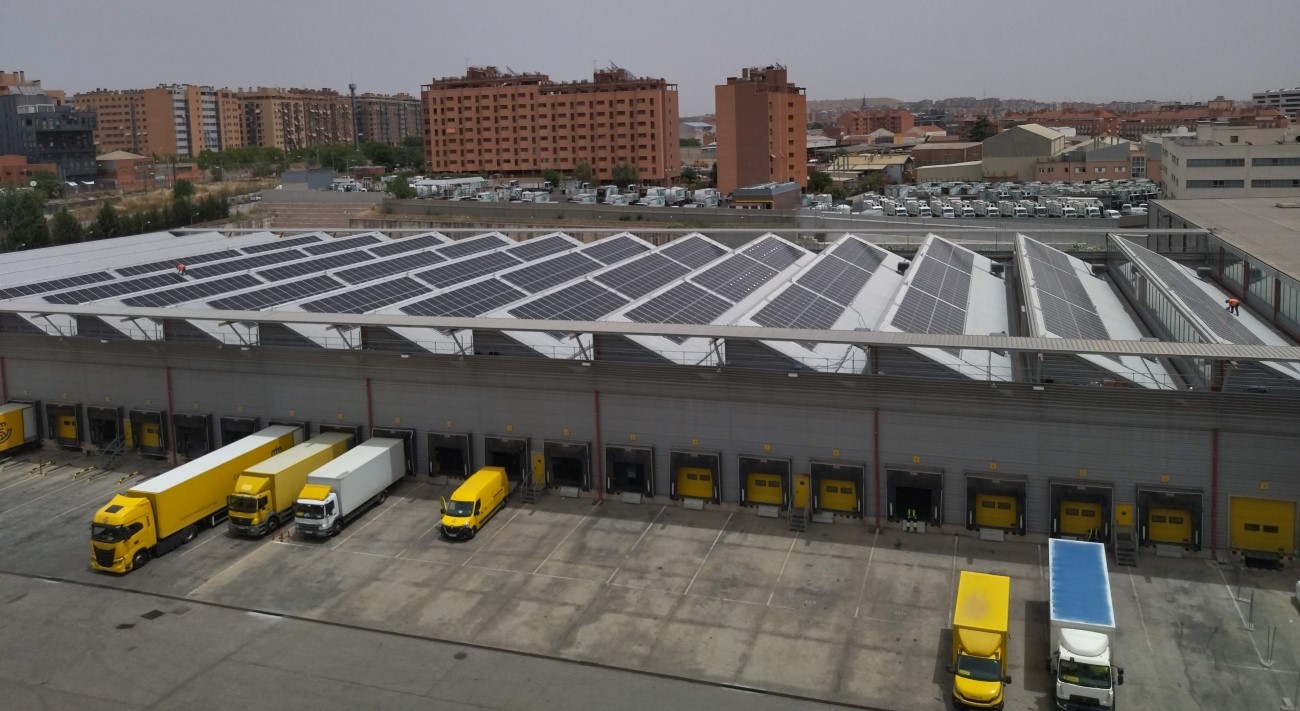
- Correos continues to strengthen its commitment to solar energy with the installation of new self-consumption photovoltaic plants in Barcelona, Valencia, Alicante, and Seville, which will cover 22% of the energy consumption of these centers.
- Its largest logistics platform, the Madrid Automated Treatment Center (CTA), already generates more than 21% of its energy through photovoltaic self-consumption. Furthermore, six additional plants are expected to come into operation in 2026 in Las Palmas, Santa Cruz de Tenerife, Málaga, Madrid, Palma de Mallorca, and Vitoria.
- With the new Correos Solar installations—which will bring the total number of solar plants to 12 by the end of 2026—and thanks to the company’s increasing electrification, which already represents 84% of its energy consumption, the company achieved a 6.4% reduction in its electricity expenses in 2025
Correos continues expanding in its sustainability strategy through the expansion of the Correos Solar project, including five new self-consumption photovoltaic plants in some of its main Automated Treatment Centers (CTAs). The objective is to generate a significant portion of the energy used in these facilities, reinforcing its commitment to energy efficiency and emissions reduction.
This year, solar installations will come into operation at two logistics centers in Barcelona—Sant Cugat del Vallès (450 kWp) and Barcelona Colón (93.74 kWp)—as well as in Alicante (400 kWp), Valencia (455 kWp), and Sevilla (528 kWp). On average, these plants will enable 22% of the energy consumed to come from renewable sources generated on-site.
The postal company launched the Correos Solar project in 2022 with the installation of 960 high-efficiency 540 kWp panels at the Automated Treatment Center (CTA) in Madrid, giving its largest logistics center an installed capacity of 518 kWp, making it the largest self-consumption photovoltaic plant of its kind. This infrastructure is generating an average of 719,122.94 kWh/year of renewable self-consumption electricity, 22.14% of the CTA’s annual energy consumption, equivalent to the annual usage of 280 households.
Correos has now started a new expansion phase that will add six more solar plants before year-end. Self-consumption installations currently in the contracting phase will be located in Las Palmas (190 kWp), Santa Cruz de Tenerife (120 kWp), the Madrid International Exchange Office – Rampa 7 (690 kWp), as well as sites in Málaga (110 kWp), Palma de Mallorca (280 kWp), and Vitoria (420 kWp). Together, these plants will cover approximately 29% of the energy consumed by these centers.
With this deployment, Correos is expected to have 12 major photovoltaic self-consumption facilities by the end of 2026, with no grid feed-in and a total installed capacity of 4,255 kWp. This will result in an estimated annual production of between 5.5 and 6.8 million kWh, enough to supply between 1,500 and 2,000 households, assuming an average household consumption of 3,000 kWh/year.
Installing self-consumption photovoltaic generation plants requires a large surface area of panels, which can reach between 20,000 and 25,000 square meters. In the case of Correos, these are located on the rooftops of buildings to optimize space usage.
The company’s goal is to extend the project launched in 2022 to a total of 21 buildings over the next three years, enabling an estimated cumulative savings of €4.3 million in energy costs and an approximate production of 25 million kWh in the 2024–2028 period. The contracting model—pioneering in the Spanish public sector—combines the purchase of 100% renewable electricity produced by Correos’ own facilities with the comprehensive maintenance of the photovoltaic plants.
Energy Efficiency Measures
In addition to installing photovoltaic generation plants in its logistics centers, Correos has long prioritized the use of electric energy in its buildings. Since 2018, 100% of the electricity purchased by Correos comes from fully renewable energy sources with guarantees of origin, resulting in avoided emissions averaging 24,000 tons of CO₂ per year.
Recent energy efficiency measures adopted by the postal company include the progressive replacement of diesel boilers in its buildings, which will help reduce total energy consumption in 2026.
Over the past year, the company has neutralized the CO₂ emissions associated with its total natural gas consumption. To achieve this, 90% of emissions were voluntarily offset through Certified Emission Reductions (CERs) under United Nations standards. The remaining 10% was offset with CO₂ absorption credits from reforestation projects certified by the National Carbon Footprint and Absorption Projects Registry of the Ministry for Ecological Transition and Demographic Challenge.
In energy management, a national remote management system has been implemented in 571 offices across Spain. This system monitors and regulates consumption, lighting, and climate control to improve operational efficiency. It is enabling an annual energy savings of 1,331,000 kWh. Measures include adjusting lighting operation to match center activity and regulating temperatures according to mandatory regulations applicable to Correos and the Spanish public administration. Average energy consumption savings achieved in offices with this system exceed 20%.
Additionally, with the implementation of LED lighting in its delivery centers and offices, Correos has established itself as one of the leading companies in the Spanish distribution sector in sustainable mobility, with the largest fleet of “zero-emissions” and ECO vehicles. Correos has more than 4,000 vehicles based on alternative technologies, and its goal is for 50% of its fleet to be sustainable (electric, hybrid, and compressed natural gas vehicles) by 2028, in line with its new 2024–2028 Strategic Plan.
As part of this fleet electrification plan, the Correos Recarga initiative has deployed 696 charging points for four-wheel electric vehicles and 2,562 for two-wheel vehicles. In 2025, the energy charged reached 1,639,587 kWh, with more than 187,900 recharges performed, further promoting cleaner and more efficient mobility.
Source: Correos