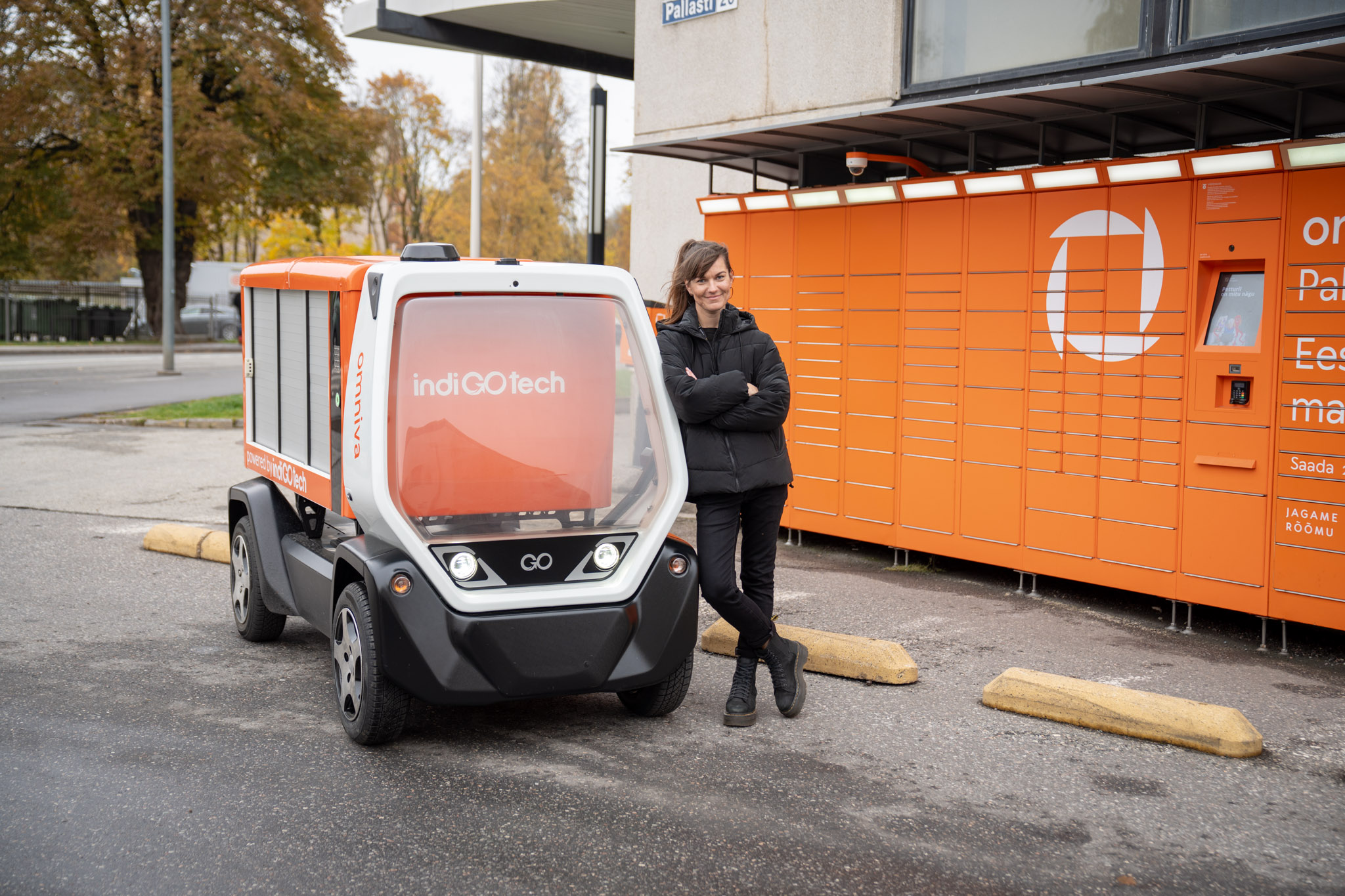
It’s easy to talk about autonomous parcel vehicles as the next technological breakthrough set to transform city streets. Getting them to deliver real parcels in real traffic is far more challenging.
International technology and logistics group Omniva spent five months testing autonomous parcel deliveries on the streets of Tallinn. The conclusion was clear: while today’s technology has reached an impressive level of maturity, adapting cities and infrastructure to support driverless vehicles remains the biggest challenge.
Over the past few years, autonomous vehicles have become a frequent topic of discussion. We are seeing more pilot projects across Europe – in Belgium, Slovenia and elsewhere – where postal and logistics companies are testing automated delivery technologies to reduce last-mile costs and improve efficiency. Yet fully autonomous vehicles remain a rare sight in everyday traffic.
Omniva decided to take the next step by moving beyond controlled testing environments and putting autonomous vehicles into real-life operation. We deployed them on the streets of Tallinn to deliver real parcels to real customers.
The pilot lasted five months, during which the autonomous vehicles successfully delivered 23,217 parcels.
The vehicles used in the pilot were remotely supervised by a single operator capable of monitoring – and, when necessary, taking control of – three driverless vehicles simultaneously. In a way, Estonia gained its first parcel courier who could work remotely from home.
Machines don’t make emotional decisions or break traffic rules
The pilot confirmed that autonomous driving technology has reached a very high level of reliability. The vehicle behaves exactly as it has been programmed to. It doesn’t suffer from sleepless nights or bad days that affect concentration or attention. For the vehicle, traffic rules are absolute. It won’t speed through a yellow light or make impulsive decisions.
As with any new technology, we encountered a small number of technical incidents during the pilot.
On two occasions, the vehicle stopped unnecessarily in front of tram tracks because its sensors mistakenly identified them as obstacles. In another instance, a software issue caused one of the vehicle’s cameras to freeze, resulting in a minor collision with a parked car. Once these issues were identified, the manufacturer was able to implement improvements quickly – which is exactly the purpose of real-world pilot projects.
Looking more broadly at global statistics on autonomous vehicles, serious accidents remain rare compared with conventional road traffic. That doesn’t mean the technology is infallible, but it does demonstrate that development is moving in the right direction, with safety remaining the highest priority.
One limitation, however, is that the vehicle cannot communicate directly with other road users, whose behaviour can often be unpredictable. One lesson from the pilot was that future autonomous vehicles could benefit from having a microphone, allowing the remote operator to speak with pedestrians or other drivers whenever necessary.
For the most part, however, the autonomous delivery vehicles attracted positive attention. People regularly stopped to film and photograph them, and during the Christmas season, one of the vehicles even delivered gifts to a children’s home in Viimsi.
Technology is more advanced than the cities it’s operating in
Although the technology handled most situations successfully, it quickly became clear that today’s urban environment is not yet fully prepared for autonomous vehicles.
One surprisingly difficult challenge involved access barriers. Barrier gates operate differently depending on the location. A human driver can usually adapt and find a solution, but a machine follows predefined rules. When reality falls outside those rules, the vehicle simply stops.
Similarly, the vehicle automatically comes to a halt whenever its connection with the remote operator is interrupted or the video feed freezes. This behaviour is essential from a safety perspective, but it can understandably frustrate other road users.
The autonomous vehicles tested were also limited to a maximum speed of 25 km/h, meaning they could not be used on every delivery route.
Significant cost-saving potential and clear environmental benefits
Naturally, one of our key questions was whether autonomous logistics could also make economic sense.
During the first months of the pilot, the cost of delivering a parcel was significantly higher than delivery by a conventional courier van. However, by the end of the pilot we had reached a much more promising level of efficiency.
Today, we believe that in the future it will be possible to provide autonomous logistics services at at least half the cost of traditional courier transport. The question is no longer if this will happen, but when we will be able to achieve it.
While reaching full commercial viability may still take time, the environmental benefits are already evident.
An autonomous electric vehicle reduces CO₂ emissions and energy consumption for several reasons. Unlike conventional diesel vans, it produces no direct tailpipe emissions, and its energy consumption is substantially lower.
Even compared with a conventional electric delivery van, the advantages are significant. The vehicle’s smaller size and lighter weight require less electricity, while eliminating the need to transport a driver further reduces energy consumption. In addition, autonomous vehicles can travel at a more consistent speed along optimised routes, avoiding unnecessary acceleration and braking that would otherwise increase energy use.
When serving MicroHUBs or completing short urban transport loops, an autonomous vehicle can consume 2-4 times less electricity than a conventional electric van, and 5-8 times less than an equivalent diesel van. At the same time, it helps reduce noise, traffic congestion and urban air pollution.
Autonomous logistics is the future
The most valuable outcome of Omniva’s autonomous vehicle pilot was testing it in real-life conditions.
Only when autonomous vehicles serve real parcel lockers and real customers every day can you truly understand both their potential and their limitations.
Today, we no longer ask whether autonomous logistics is possible. We know it is.
Our pilot demonstrated that the technology itself is no longer the primary obstacle. The real challenge is how quickly we can integrate these advanced technologies into our cities, infrastructure and operational processes – moving them from pilot projects and technical demonstrations into everyday business.
One thing is certain: autonomous logistics has enormous potential. Omniva will continue testing next-generation logistics solutions, including different types of autonomous vehicles, as we work to shape the future of parcel delivery.
Source: Omniva