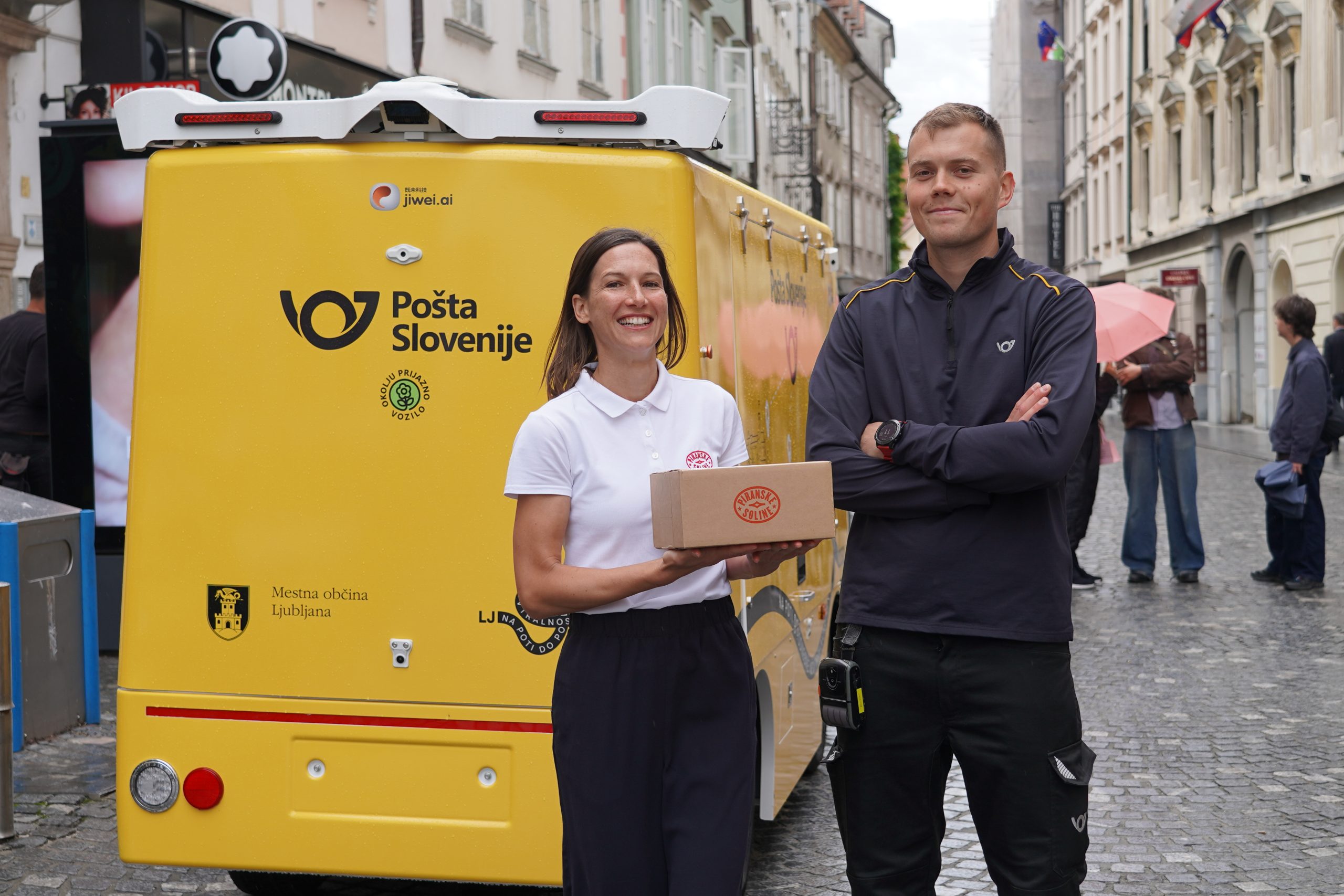
At the beginning of June, Pošta Slovenije and the City of Ljubljana introduced a trial of a new concept for urban delivery and mobile city services in the pedestrianised zone of the city centre. Through assisted robotic delivery, they demonstrated in a real-world urban environment how modern technologies can contribute to the development of delivery to the final recipient, or last-mile logistics.
This marks a significant step in the development of sustainable, smart and user-friendly urban logistics, which can contribute to a more efficient servicing of the city centre, reduced traffic burden, quieter deliveries, and the development of new urban services.
Urban delivery and servicing are undergoing rapid changes. Traffic arrangements are evolving, sustainability expectations are growing, while the needs of residents, visitors, businesses and local providers remain high. For this reason, Pošta Slovenije, in partnership with the City of Ljubljana, is exploring how new solutions from the development environment can be responsibly transitioned directly onto city streets. Ljubljana is therefore the first city in Slovenia where such a concept is being tested in a real-world setting.
This is not merely about parcel delivery, but rather a broader model of urban delivery of various items and services in the city centre. In the future, such solutions could include the delivery of small retail purchases, local products, beverages, snacks, basic hygiene items, and tourist information, or even the provision of services to visitors at public events. As they develop further, they could also take the form of mobile kiosks or mobile pick-up points, moving closer to people where they need them most at a given moment.
“When we began gradually closing the city centre to motor traffic nearly 20 years ago, the greatest sceptics feared that the city would lose its vitality. But the very opposite happened. Today, the city centre is car-free, giving priority to pedestrians and cyclists, and it is full of life and diverse social activities. We have the largest pedestrianised zone in Europe, spanning nearly 20 hectares. I am therefore particularly pleased that, together with Pošta Slovenije, we have launched this pilot project, which utilises modern technology to support the city’s sustainable development. I believe our residents will embrace this new form of automated delivery in the city centre. This is yet another step on our path towards carbon neutrality under Mission 100,” highlighted the Mayor of Ljubljana, Zoran Janković.
“With this trial, we are embarking on the development of a delivery and supply model tailored to modern cities. Today robotic delivery technologies already offer autonomous functionalities; however, due to the legislative framework, we are introducing them gradually, responsibly, and in a controlled manner. Our aim is not to replace existing forms of delivery, but rather to supplement where traditional models are becoming less efficient – particularly in city centres, areas with restricted traffic, tourist hotspots and at public events,” said Marko Cegnar, Director General of Pošta Slovenije, at the event.
He also emphasised that the role of Pošta Slovenije is changing. Long recognised primarily as a traditional postal operator, the company is increasingly acting as a development partner in the introduction of advanced logistical and digital services. Pošta Slovenije is already investing heavily in the automation of parcel and letter logistics, the expansion of its network of parcel lockers and other pick-up and drop-off points, and the development of digital services that provide users with greater transparency, flexibility, and control over their deliveries.
Pošta Slovenije’s strategic direction is further validated by numerous domestic and international awards in the fields of digitalisation, innovation and delivery quality. The company is also actively involved in European development projects, such as TRACE, where, together with more than 20 partners from across Europe, it is developing models of smart, quiet and carbon-free last-mile delivery. It is precisely from these projects that the expertise and solutions originate which Pošta Slovenije, in partnership with the City of Ljubljana, is transferring into a real urban environment.
Delivery to the final recipient, or the last mile, remains a particular challenge in modern logistics, being one of the most cost-intensive and operationally demanding segments of the logistics chain. In this context, autonomous and assisted delivery solutions are emerging as a vital complement to existing models, particularly in dense urban areas, pedestrian zones, and in connecting urban consolidation centres with nearby delivery or pick-up points.
According to Pošta Slovenije’s estimates, such solutions are expected to become established in limited but specific use cases within urban centres over the coming years. Their wider deployment, however, will depend on the development of the related technology, infrastructure, user experience, and legislative framework.
The presentation was followed by a practical demonstration of the delivery along the route from the City Hall to the Soline shop, where the first symbolic delivery took place.
Source: Pošta Slovenije